What are boundaries and do I have them?

Imagine drawing a line in the sand. Now imagine on the otherside of that line is everything you never want to do as a person. It could be cheating in a relationship, spanking as a form of child discipline, or even something as simple as working late when you don’t get paid overtime. All of those things that you do not want for yourself are boundaries that you have set for yourself. Boundaries can be guidelines that we have in place for ourselves that tell us we are doing the right thing. Boundaries can also be our way of teaching others how to treat us.

The interesting thing about boundaries is that we have them in place, even if we are not aware of them. Imagine that you are talking with someone that you don’t know very well. As this person is talking to you, they get really close to you and you feel that they are right in your face. What do you do? Our natural instinct might be to take a small step backwards or to the side. Or even to shift our body in a way where it feels like the person talking to us is not on top of us. This is a boundary. A physical boundary; otherwise known as your bubble. Everyone has a comfort level on the distance a person is from them when engaging in conversation.

There are many different types of boundaries that a person can have that I will go over. How to set those boundaries will be a post for a different day. My focus with this topic is to help bring some awareness of what our boundaries are, what they can look like, and if you are not sure what your boundaries are to get you thinking on what you might want your boundaries to be. Before I dive in, there are a couple of things that I do want to make note of.

1. Boundaries are not rules. Boundaries are not meant to control the way another person reacts. Boundaries are simply put in place to make sure that you are remaining safe and that others are treating you with respect. Think of boundaries like guidelines or expectations.

2. Your boundaries can change! Boundaries can be flexible and can be changed as you see fit. When you first start implementing your boundaries you might be very firm with them. As you grow, make changes, etc, your boundaries can adjust and change as well.

3. Do not set a boundary that you cannot keep. If you cannot follow through with maintaining a boundary do not put it in place. If you allow others to disrespect your boundaries, you are teaching them that the boundary in place is not important and that they can continue to disrespect it.

4. People don’t know what they don’t know. If you do not communicate your boundaries with others they will have no way of knowing what your boundaries are. If you are bringing your friend to work and you have to work at 8 and you get mad at your friend by not being ready to go at 7:30, and you did not let your friend know that they needed to be ready to leave at that time; it is unfair to your friend as they were unaware of the time boundary that you set and did not communicate.

Now that we have some basic understanding of boundaries let’s dive in to the different types of boundaries we can have.

Physical Boundary: this is our personal space and what we are okay with in regards to physical touch. This boundary is violated when someone invades your personal space or touches you in a way you do not want to be touched.

Intellectual Boundary: this is our thoughts and our ideas. This boundary can be violated when our thoughts or ideas are dismissed or belittled.

Emotional Boundary: this is about our emotions and feelings. This boundary can be violated when we share more information than we are comfortable doing. This can also be violated when our feelings and emotions are dismissed, criticized, invalidated, or belittled.

Sexual Boundary: this ties in the emotional, intelluctal, and physical aspects of sexuality. This boundary can be violated if we engage in sexual acts that we are not comfortable with. This can also be violated when we receive unwanted sexual touch, are pressured to engage in sexual acts, are humiliated about sexual acts, and/or having sexual comments made towards you.

Material Boundary: this is about our money and possessions. This can be violated when you have money or possessions stolen from you, others pressure you to giving or lending money or possessions, or when you have borrowed money or possessions and they have not been returned.

Time Boundary: this is about how we use our time. This can be violated when we don’t respect our own time. This can also be violated when others do not respect your time or demand too much of your time.

So what are your boundaries? Or, what do you want your boundaries to be? Boundaries are important. Boundaries give us the opportunity to not only respect ourselves, but to ensure that others are respecting us as well. Remember, we teach others how to treat us. So as you examine your boundaries, or begin to create them, make sure you are communicating with the people you need to so they can treat you the way you want, and deserve, to be treated. I wish you all well on this journey of self-discovery. Be well, and most importantly, be kind to yourself.
The Serenity Prayer

This simple prayer is most commonly associated with AA/NA meetings as a form of opening and/or closing the support session. However, in the middle of a global pandemic, the Serenity Prayer can be a useful reminder for everyone. With such a large scale crisis, it can be easy to feel as if things are completely out of control and that we are powerless and unable to do anything. If you are like myself, you might struggle from time to time with the need to control. When you are in control of a situation, you can better predict the outcome of the situation which can lead to feeling less anxious, more powerful, more capable, and many other positive things.

The downside of this need to control is that not everything is 100% in our control. And when things out of our control occur we can feel, well, crazy, and anxiety-ridden, depressed, helpless, etc. What we need to remember is that we cannot control life. Life is going to happen on it’s own terms, whether you like what happens or not. That is where the Serenity Prayer comes into play.

God, Grant me the Serenity,

to accept the things I cannot change,

the courage to change the things I can,

and the wisdom to know the difference.

(2003). The serenity prayer: Faith and politics in times of peace and war. New York: Norton.

If you are not religious, you can simply remove the word ‘God’, the message remains the same. There are things that will occur in our lives that we cannot control and do not know what the outcome will be. If we do not accept this, we will be stuck. That being said, even when things feel out of control, scary, or chaotic, there is one thing that we can control: how we respond to the situation/event or ‘change the things I can’. Even when things are not in our control, we are still in control of ourselves. We can control how we respond during conflict, even though we cannot control how someone responds to us. We can control how we show up in our lives, even when we cannot control some of the events that occur in our lives.

And finally, knowing the difference. Understanding what is and is not in our control in order to act accordingly. We are living in a very uncertain time and tensions can feel high. This does not mean all is lost. Using the pandemic as an example: I cannot control that we are in the middle of a pandemic. What I can control during this time is washing my hands frequently or wearing a mask when I need to go to the store. I can also practice social distancing as a way to keep myself and others safe. I cannot control the way others may respond to this pandemic. I cannot control if someone chooses not to wear a mask or not practice social distancing.

While it may be frustrating or nerve-racking to see other people respond to situations in an unhealthy way, it is not our responsibility to make their decisions for them. People learn when they make mistakes. If people are not allowed to make mistakes, how do we expect them to learn and grow?

I hope everyone reading this is able to find some sense of serenity during this time and is able to find that balance and wisdom of what can and cannot be controlled. Letting go of control is not easy, and once we find the ability to do so, we find ourselves living more in the moment and accepting life as it comes to us; which allows us to enjoy this journey. Be safe, be well, and most importantly, be kind to yourself.

I Am Not My Past Mistakes

Repeat after me. I am not my past mistakes. I am worthy of change. I deserve to change and to move forward. I can change. I will change. I deserve to be happy and at peace with myself. I deserve to love myself. Repeat as many times as necessary.

If you want to move forward in your life, you cannot allow your past mistakes to prevent you from moving forward. Because they will. They will tie you down and eat you from the inside out. Time and time again, I have seen individuals engage in self-sabotaging behaviors, because they believe that they do not deserve to move forward, they do not deserve to change for the better, they do not deserve to be happy, because of the mistakes they have made in the past.

The person you were when you made those mistakes is not the person that is reading this today. Even if the mistake you made happened yesterday, or even an hour ago. We all have the ability to tell ourselves that we are not going to be that person any longer, and we can change.

Sometimes people believe that they do not deserve to change, not because of the mistakes they have made, but because someone told them that they were bad and it became internalized. When we internalize something, it becomes a part of who we are, a part of our identity. Growing up, my family was poor and domestic abuse was the norm. When I was 7 or 8 years old, my mother told me to never rely on anyone for anything. To make my own way so I would never have to depend on anyone.

Of course my mother said that with the best intentions. She didn’t want me to end up in a position like her, where she did not have choices. My mother couldn’t leave the situation she was in. She had 3 children, no job, and no family in the state. She was stuck. She wanted more for me than that. How my 7 or 8-year-old self interpreted it, however, was that people cannot be trusted, and you can only trust yourself. I internalized that.

I didn’t have many close friends for a long time because of that. I did not cry in front of others; I did not allow myself to be vulnerable with others. I did not ask others for help. I did things my way, because I could not trust the ways of others. The abuse I endured during my childhood, also had me believing that I was worthless, that I would never amount to anything, that I was stupid, a loser, etc. The list goes on.

Anytime I started to grow close to someone, I would sabotage it. Because I believed that I did not deserve to be treated kindly. I believed that I was a bad person. I destroyed relationships with others and this fed into the belief that I was a bad person. I was a bad person, who did not deserve to have good relationships because of the bad things I did to my relationships. This came from internalizing the words my mother told me, and also stemmed from the abuse I endure as a child.

So how does one move forward from this type of cycle? If left alone, this cycle leads to a very lonely life. In my experience, if you want to change this cycle, you need to change the way you think. You have to tell yourself that you don’t want to be that person anymore. You have to actively work to correct your negative thoughts that tell you otherwise; you have to go against your natural instincts to not engage in the behaviors you typically would engage. Typically, we want to sabotage because we begin to feel uncomfortable. We feel uncomfortable because the way we are behaving, or the things that are being said to us, are the opposite of everything we have experienced and have been told thus far.

I find that positive self-talk is the best way to start healing from this. Changing negative self-talk and sabotaging behaviors is a process, so we don’t want to overwhelm ourselves and take on too much, too soon; that is a fast way to sabotaging. I challenge my clients by encouraging them to give themselves positive self-affirmations. Example: Negative thought-I am stupid at Math. Correction-I am intelligent and am learning how to do Math in a new way.

Next I encourage my clients to practice accepting the kind things people say about them and then flip the statement into a self-affirmation. Example: You did a good job on that project. I-Statement-I did a good job on that project. When my clients find themselves not believing what someone has said about them, I ask them ‘why?’. Has this individual given them a reason not to believe what was said? Why would they lie? Why would they say something, at random, if it were not true? You don’t get to decide the good things that others are able to see in you, just because you are not able to see them yet.

You may have heard that when we hear something negative about ourselved enough times, we begin to believe it. The same thing goes for the positive. If you or others tell yourself something positive enough times, you will begin to believe it to be true. When I first began my career, I was filled with self-doubts. I did not think that I was capable of helping others, and did not think that I was able to convey what I wanted to say in a way that would be understood by my clients. My supervisor and clinical director gave me words of encouragement and I would always follow up with my doubts, despite the kind words they said to me about my capabilities. Finally, my supervisor asked me if I thought that my supervisor and clinical directors were liars. I was shocked. Of course I didn’t think they were liars. She asked me then why I didn’t believe them when they told me I was capable. I was unable to give her an answer. It was a big eye opener for me and it showed me just how powerful negative thinking can be.

You have the power and ability to stop this cycle. You are not your past mistakes. You are not a bad person. You are worthy of change. You deserve to change. You deserve to be happy. You deserve to be at peace. You can change. You will change. You will become the person you want to be. Changing a negative mindset is not something that happens overnight. It is okay if you don’t achieve this immediately. This isn’t about doing an exercise correctly. It is about learning to love yourself. Learning to love yourself is not easy; so go easy on yourself, and be kind to yourself. I wish you well on this journey of self-love.

Exercise: Give yourself a positive affirmation (something you like about yourself) everytime you see your reflection in the bathroom mirror. It should not be a physical characteristic. It should be something that you like about the person you are.

Exercise: Keep a journal and write down any negative thoughts that you have about yourself, or anything negative anyone says to you about you, throughout the day. At the end of the day, go back and correct all the negative thoughts and replace with them with positive I-Statements.

Lets Talk Triggers.

People, places, and things. Just about anything can be a trigger. Seasons, the time of day, moods; so if anything can be a trigger, how do we know what our personal triggers are? And why is it so important to know what they are?

The word ‘trigger’ is thrown around a lot these days. Many people will use the word ‘trigger’ in a negative way when they do not like the way someone responded about a given situation. In the mental health field, a trigger is a stimulus that creates a psychological reaction in the brain that is associated with the symptoms of the mental health disorder. For example, someone who has experienced trauma, may experience a traumatic response when they are in a situation that is similar to their traumatic experience. So if I was in a terrible car accident, I may experience intense anxiety, or flashbacks, when I drive my car, or even if I see a car that looks similar to the car involved in my accident. With addiction, the stimulus is anything that has been associated with the preparation of, or the use of a substance or addictive behavior.

This leaves a very broad range for what could potentially be a trigger. So how do we identify our personal triggers? The easiest way is to break it down into categories. There are two categories of triggers: internal and external. Internal triggers have to do with the individual directly, such as moods and feelings. External triggers, on the other hand, are going to be anything outside of ourselves. This can be certain people, times of day, situations, places, things, etc.

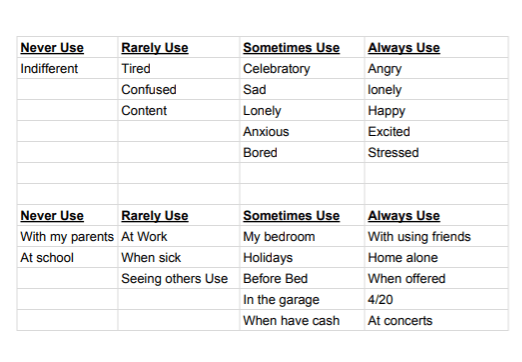
Taking it a step further, when trying to identify personal triggers, I find it easiest to make a chart. Label each section of your chart with ‘Never Use’, ‘Rarely Use’, ‘Sometimes Use’, and ‘Always Use’. Under each of these, start with internal triggers and go through the chart. What moods/feelings do I always, sometimes, rarely, and never use when I experience them? Then you can create another chart for external triggers with the same layout. What are the places, people, things, etc. where I always, sometimes, rarely, and never use. When you are done, make note of what you wrote down under the always and sometimes sections. Those are your main triggers and it is very important to be aware of those specific triggers, so you can do what you can to avoid them, and you can be prepared for when they occur.

Example: Internal triggers on top, exernal triggers on bottom.

Remember Pavlov? The famous Russian psychologist who founded classical conditioning? You may know him from his famous experiment where he conditioned dogs to associate food with the ringing of a bell. He would ring a bell and present the dog with food. The dogs would salivate when they saw their food. Over the course of time, just hearing the ringing of the bell, the dogs would associate the sound of the bell with food. So by hearing the bell, the dogs would begin to salivate. This is a simple example of how a trigger can be formed. The trigger being the sound of the bell. When the dogs heard the bell, their brains told them that they were about to receive food, so the dogs would begin to salivate. The exact same thing happens when people experience triggers. They feel, see, or experience the trigger and their brains respond accordingly. This is how people can have panic attacks and not know what led to it, or how someone with an addiction can relapse and not know what led up to it.

A simple way to think about it is based on our experiences we have conditioned our brains to associate people, places, and things, with our specific experiences and our brains will then respond to what it believes it is experiencing. Lets use my car accident example again. Because I was in a terrible car accident, my brain will associate driving a car, or seeing similar cars with the experience of the car accident. Because of that association, my brain responds as if I am actually experiencing the car accident and can lead to me experiencing increased anxiety or flashbacks. For individuals with addiction, triggers are associated with the preparation or use of a substance. So when I experience a trigger, my brain is telling me that I am about to use and this can lead to cravings.

I think it is important to note that triggers don’t just occur for individuals with mental health disorders. There are things that we experience in our lives that can trigger anger, sadness, pain, etc. However, developing an awareness of your personal triggers helps us learn how to manage any mental health symptoms, and how to manage our emotions. Triggers suck. There is no easy way to know all of your triggers, or know when they will occur. But having that awareness gives you the opportunity to prepare for them so when you do experience them, they won’t always have the same affect. We can overcome triggers, and it all starts with awareness.

Why Can’t I Just Stop?

Have you ever asked yourself this question? Have you ever wondered how someone could have only one drink? Or just one hit? Has anyone ever expressed concern to you about your drinking or using habits? Do you continue to drink or use, knowing that something is different about the way you drink/use compared to others? If you have not asked experienced any of that, congratulations. You more than likely do have an addiction.

So what does qualify as an addiction, or a substance use disorder? Some will say that it is the substance you are using that defines addiction, as many people will associate addiction with hard drugs, like Methamphetamine or Heroin. In reality, addiction is not what you are using, but rather how your body responds to a substance/behavior and how your drinking or using is impacting you.

So how do you know if your body is “responding” in a way that is out of the norm? Luckily, no matter the substance, the behaviors or symptoms that an individual experiences to qualify for a substance use disorder are the same. The DSM-5, the Diagnostic and Statistical Manual of Mental Disorders, fifth edition published by the American Psychiatric Association, has 11 symptoms that individuals can experience when they have become addicted to a substance.

1. Consuming more than origninally planned. Example: I go to a party where I had a plan to only have 2 drinks because I have to get up for work in the morning. I get blackout drunk.

2. Spending a lot of time preparing to use, using, and/or recovering from using. This one can look like a few different things. Examples: I am at work and all I can think about is how I am going to get high when I get home. I have to take time to get a hold of a dealer to find out who can provide me with my substance. I have to go all the way across town, or even go to another town, to obtain my substance. If I am not at work, most of my day is spent using. After a night of drinking, I will spend the majority of the next day hungover.

3. Experiencing cravings, or urges to drink or use. Example: You don’t understand, I NEED a drink.

4. Finding yourself needing to drink or use more to achieve the same effect. Example: Two drinks would get me drunk before, but now I have to have 4 drinks just to feel buzzed.

5. Experiencing withdrawal symptoms. Examples: Going too long without drinking makes my hands shake. I feel physically ill if I don’t use. I get extremely irritable if I don’t have any substance left.

6. Drinking or using has led you to slacking, or even giving up, on your respondibilities at work, school, or home. This can look like a few things depending on your age. Examples: I frequently show up late to work, miss work, or even quit jobs because of my drinking/using. I am not as effiecient at my job as I was before my drinking/using. I show up late to school, have missed school, have quit school because of my drinking/using. I have made late bill payments, missed payments, or cannot make my payments because of my drinking/using; maybe you have even been evicted.

7. Drinking or using has impacted your relationships. Again, this can look different based upon your age. Examples: Over the past year, I have stopped spending time with friends who do not get high, and spend more time with friends that do get high or can provide me with substances. I have stopped seeing friends and family and tend to isolate. My marriage has been strained due to my drinking/use. I am not as close to my parents as I use to be. Friends have stopped inviting me to go to the bars with them.

8. Having drank or used in situations that would be deemed dangerous. Examples: I drive after drinking/using. I do things when I am drunk/high that I would not do when I am sober. I have been violent while under the influence. I have had unprotected sex while under the influence. I have shared needles with others.

9. Attempting to discontinue or cut down your drinking or using and not being able to. Ultimately this is attempting to set limits for yourself and going beyond those limits. Examples: I told myself I would only drink on the weekends. I can only go a few days or a week or two without drinking or using.

10. Giving up on social, occupational, or recreational activites, that were once important to you, in order to drink or use. Examples: I stopped going to family gatherings so I could drink or use, OR because I was drunk or high. I stopped engaging in my hobbies because I would rather spend my time drinking or using. I use to love going to church but don’t go now because I am usually hungover.

11. Continuing to drink or use despite knowing that you have a physical or psychological problem that could be caused by, or made worse by, your drinking or using. Examples: I self-medicate my anxiety/depression with my drinking/use. I continue to drink, despite my doctor telling me it can negatively impact my diabeties.

You need to meet at least 2 of the 11 criteria within the past year to qualify for a substance use disorder. You can have a mild, moderate, or severe substance use disorder. Meeting 2-3 of the criteria qualifies for a mild substance use disorder, 4-5 is a moderate substance use disorder, and 6+ qualifies for a severe substance use disorder. As I mentioned earlier, addiction is not about how much you were using, it is about how your drinking or using impacts your day-to-day life. If you are reading this and realize that you may have a problem with a substance, I strongly encourage you to seek professional guidance.

Addiction and chemical dependency is not a moral failing. If you need to, repeat that sentence to yourself. And, there are solutions! From 12-step programs to harm reduction to anonymous support meetings, there are options out there for you; if you feel the need, or feel ready, to make a change. Having an addiction is nothing to be ashamed about. People do not wake up one day and think “I am going to get addicted to something.” There is a chemical change in the brain, just like any other mental health disorder. And just like any other mental health disorder, there is no cure for it, but you can learn how to manage your symptoms. Everyone’s process is different, and if you are beginning your journey of recovery, I wish you nothing but the best.