People, places, and things. Just about anything can be a trigger. Seasons, the time of day, moods; so if anything can be a trigger, how do we know what our personal triggers are? And why is it so important to know what they are?
The word ‘trigger’ is thrown around a lot these days. Many people will use the word ‘trigger’ in a negative way when they do not like the way someone responded about a given situation. In the mental health field, a trigger is a stimulus that creates a psychological reaction in the brain that is associated with the symptoms of the mental health disorder. For example, someone who has experienced trauma, may experience a traumatic response when they are in a situation that is similar to their traumatic experience. So if I was in a terrible car accident, I may experience intense anxiety, or flashbacks, when I drive my car, or even if I see a car that looks similar to the car involved in my accident. With addiction, the stimulus is anything that has been associated with the preparation of, or the use of a substance or addictive behavior.
This leaves a very broad range for what could potentially be a trigger. So how do we identify our personal triggers? The easiest way is to break it down into categories. There are two categories of triggers: internal and external. Internal triggers have to do with the individual directly, such as moods and feelings. External triggers, on the other hand, are going to be anything outside of ourselves. This can be certain people, times of day, situations, places, things, etc.
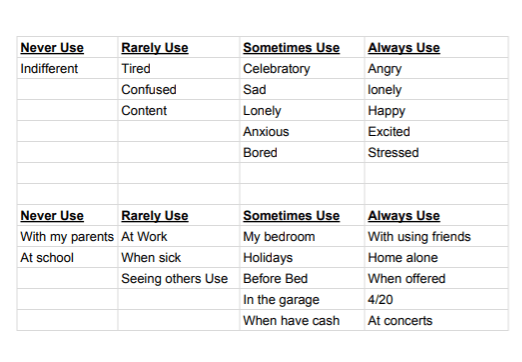
Taking it a step further, when trying to identify personal triggers, I find it easiest to make a chart. Label each section of your chart with ‘Never Use’, ‘Rarely Use’, ‘Sometimes Use’, and ‘Always Use’. Under each of these, start with internal triggers and go through the chart. What moods/feelings do I always, sometimes, rarely, and never use when I experience them? Then you can create another chart for external triggers with the same layout. What are the places, people, things, etc. where I always, sometimes, rarely, and never use. When you are done, make note of what you wrote down under the always and sometimes sections. Those are your main triggers and it is very important to be aware of those specific triggers, so you can do what you can to avoid them, and you can be prepared for when they occur.
Remember Pavlov? The famous Russian psychologist who founded classical conditioning? You may know him from his famous experiment where he conditioned dogs to associate food with the ringing of a bell. He would ring a bell and present the dog with food. The dogs would salivate when they saw their food. Over the course of time, just hearing the ringing of the bell, the dogs would associate the sound of the bell with food. So by hearing the bell, the dogs would begin to salivate. This is a simple example of how a trigger can be formed. The trigger being the sound of the bell. When the dogs heard the bell, their brains told them that they were about to receive food, so the dogs would begin to salivate. The exact same thing happens when people experience triggers. They feel, see, or experience the trigger and their brains respond accordingly. This is how people can have panic attacks and not know what led to it, or how someone with an addiction can relapse and not know what led up to it.
A simple way to think about it is based on our experiences we have conditioned our brains to associate people, places, and things, with our specific experiences and our brains will then respond to what it believes it is experiencing. Lets use my car accident example again. Because I was in a terrible car accident, my brain will associate driving a car, or seeing similar cars with the experience of the car accident. Because of that association, my brain responds as if I am actually experiencing the car accident and can lead to me experiencing increased anxiety or flashbacks. For individuals with addiction, triggers are associated with the preparation or use of a substance. So when I experience a trigger, my brain is telling me that I am about to use and this can lead to cravings.
I think it is important to note that triggers don’t just occur for individuals with mental health disorders. There are things that we experience in our lives that can trigger anger, sadness, pain, etc. However, developing an awareness of your personal triggers helps us learn how to manage any mental health symptoms, and how to manage our emotions. Triggers suck. There is no easy way to know all of your triggers, or know when they will occur. But having that awareness gives you the opportunity to prepare for them so when you do experience them, they won’t always have the same affect. We can overcome triggers, and it all starts with awareness.
 Recovery Focus